Three years ago today Enrique Peña Nieto was sworn in as president of Mexico. In photos of that event, many of which will be re-printed today, he’ll be shown with the presidential sash (banda presidencial) worn over his suit coat.
Law dictates that the sash is green, white and red and has the national seal embroidered on it. It also defines how the president wears the sash — over his right shoulder, with the red on top.
It is to be worn under his suit coat unless it’s his first or last day in office — on those days he shares it with his predecessor or successor. Transfer of power is symbolically represented by the outgoing president handing the sash to his successor.
Though Mexico’s president may wear the sash at his discretion, there are days on which law specifies he must wear it. He wears it when giving the president’s annual report to Congress, he wears it on the night of the 15th of September when presiding over the commemoration of the Grito de Dolores (the Shout of Independence), and he must wear it when he receives letters of credence from foreign ambassadors.
The sash is one of two political emblems in Mexico that are synonymous to the presidency. The other is a chair.
The President’s high backed armchair is probably the grandest chair in Mexico. Referred to as La Silla Presidencial (The Presidential Chair), it has the eagle from the shield of Mexico at the top of its arched backrest.
The official photograph of President Peña Nieto that hangs in all federal government offices shows him sitting in the Presidential Chair wearing the sash.
The most famous photograph of the chair is probably one taken when it was occupied during the Revolution, fleetingly, by one who was never president — Pancho Villa. Emiliano Zapata sits beside him in a much simpler chair.
Photography historian John Mraz refers to this photograph as one of three iconic photos of the Mexican Revolution. Another is the full-figure portrait of Emiliano Zapata, leader of the Liberating Army of the South, wearing what appears to be a presidential sash – but isn’t.
The third iconic photo of the Revolution has neither a sash nor a chair. It’s an unposed and stunning photo of a woman leaning out of a train car with a rifle over her shoulder.
In 1914, Pancho Villa and Emiliano Zapata converged on Mexico City with their respective armies. They occupied the National Palace and posed for a photo with their officers. There was only one Presidential Chair but two leaders of two armies — Villa’s División del Norte and Zapata’s, Ejercito Libertador del Sur.
The oft-repeated story is that Villa offered Zapata the Presidential Chair. Zapata refused saying he didn’t want to sit in the chair so recently vacated by Porfirio Diaz. “It’s too tainted by corruption.”
Not only did Zapata refuse to sit in the Presidential Chair but he is reputed to have said he did not aspire to the presidency. Yet, his bestknown photographic portrait — a black and white photograph taken in 1911 — shows a dapper Zapata dressed as a charro, wearing a five-striped sash draped over his left shoulder. Diego Rivera copied from that photo when he portrayed Zapata in his murals in Cuernavaca’s Cortez Palace.
However, Rivera added color. He gave the photographed five-striped sash the presidential colors. He painted Zapata’s sash with red stripes at the top and bottom, a green stripe in the middle and white stripes between. The presidential sash has only three stripes.
From John Mraz, I learned Zapata was actually wearing a state of Morelos sash. By wearing it, Zapata was indicating he was the authority in the state with the right to appoint government officials.
The sash is no longer used in Morelos and I haven’t been able to determine what colors were on it, but even if they were the same as the national green, white, and red, when Zapata wore them they were state colors — hence it was not a presidential sash.
According to Mraz, the sash is the one worn by Revolutionary General Manuel D. Asúnsulo when he, with Emiliano Zapata at his side, peacefully entered and occupied Cuernavaca in 1911. After General Asunsolo’s death Zapata assumed the sash.
Though General Asúnsulo was photographed with the sash over his right shoulder, Zapata wears it over his left shoulder in his famous portrait.
Did Zapata not think that was a matter of importance? Or did he put on the sash while looking at himself in a mirror thinking he was wearing it just as General Asúnsulo had? Or is the photograph reversed left to right?
I like tradition. Today would be a good day for President Peña Nieto to wear the sash – on the third anniversary of his inauguration. Under his suit coat, of course.
Showing posts with label Zapata. Show all posts
Showing posts with label Zapata. Show all posts
Tuesday, December 1, 2015

Tuesday, November 24, 2015
Zapata Was Here
Zapata Was Here (Aqui Estuvo Zapata) is the name of a new cultural venue in downtown Cuernavaca, located in the former Moctezuma Hotel, the building stands out among its neighbors. It’s constructed entirely of un-plastered brick. Between 1911 and 1916 it was Emiliano Zapata’s headquarters, that is, whenever he was in control of Cuernavaca.
A photograph of Zapata taken in its courtyard in front of a brick wall at the base of a stairway holds the distinction of being the most frequently viewed photo of a Mexican.
Last Friday, on the anniversary of the Revolution, I climbed the stairway where Zapata posed. I was on my way to a talk by Sicilian photographer Ferdinando Scianna. His exhibit “Lux in Arcana: Ferdinando Scianna’s Baroque” opened this month (Nov. 14 to March 20) in Mexico City’s San Carlos National Museum.
The famous photo of Zapata was printed on the outside of my invitation but it seems to have been there to accompany the name of the hosting institution, not the topic of the lecture. Though generous in crediting other photographers’ work, Scianna made no reference to the portrait of Zapata.
I asked Scianna to elaborate on the difference between a painter’s portrait and a photographer’s portrait. Without mentioning Zapata’s portrait, I learned more about it than if he had projected it on the screen for analysis.
“Not many photographs of people are portraits. A portrait implies that the person being photographed is conscious of the photograph, knows about it, dialogs with the photographer and willingly poses. When people interact in this way they have an effect on one another.
“Let’s use Rembrandt as our example of a painter. Probably the most important portrait painter of all time, he also painted many self-portraits. When we see his portraits, even if we don’t know the subjects, we recognize them as his. Through his art Rembrandt gives us the presence of a person in his painting. He may have painted the portrait in the span of a month or a year — going back to the same image many times to end up with the final result — he brings that image out from within himself and offers it to us.
“A photographer, on the other hand, may spend a day, even a month, preparing a portrait of a person — telling him or her ‘angle your body this way or that’ or ‘turn your head a bit more.’ All this done before the moment the shutter is released. Regardless of the time invested preparing the photo it is still the product of an instant. In that moment the feeling — entelechy — has to be deposited in the image of that person.
“When photography works it is the miracle of an encounter which can be published and which a third-party can recognize when lining up the eye, mind, and heart. That’s complicated. Not all photographers are good portrait photographers. Nor are great photographers necessarily good portrait-takers. A good portrait photographer has to have passion for people — empathy. That could seem to say that one can only make good portraits of people one likes. However, making portraits of people the photographer detests also requires empathy. Some portraits can be manifestations of hate, others of love. Good photographic portraits tell us much about the person portrayed — just as they tell us about the photographer.”
The photograph of Zapata meets Scianna’s criteria of a great portrait. No wonder photography historian John Mraz says this photo has become a revolutionary icon. Mraz adds, “The image is of intriguing complexity and represents a startlingly graphic depiction of triumph. Zapata is dressed with the sash and sword that General Manuel Asúnsulo wore as a symbol of his status as the authority in Cuernavaca.” Asúnsulo headed the 1911 revolutionary assault on Cuernavaca but was killed shortly afterwards.
By wearing Asúnsulo’s sash and sword, Mraz explained, “Zapata was demonstrating the prerogative he’d acquired to determine who would govern the city and the state of Morelos. Wearing these emblems could also represent an attempt on Zapata’s part to legitimize his movement. He and his campesinos had been portrayed in the Mexico City press as cruel and ferocious savages. Zapata may have been attempting to counteract that mindset, presenting himself as a professional soldier, with the rank of general, and thus deserving of political recognition.
Seventeen years later, Diego Rivera would use this photo to paint Zapata in Cuernavaca’s Cortez Palace. The photo is in black and white but we assume the colors of the sash were the state colors of Morelos. Rivera uses the tri-color, thus promoting Zapata as the leader of the nation.
The portrait is attributed variously to the German Hugo Brehme or to U.S. photographer F. Wray. It is interesting that Zapata posed for a foreign photographer, perhaps because of his aversion to Mexico City’s press.
Zapata certainly made his statement in the portrait, but what was the photographer’s message with campesinos hunkered in the stairwell?
A photograph of Zapata taken in its courtyard in front of a brick wall at the base of a stairway holds the distinction of being the most frequently viewed photo of a Mexican.
Last Friday, on the anniversary of the Revolution, I climbed the stairway where Zapata posed. I was on my way to a talk by Sicilian photographer Ferdinando Scianna. His exhibit “Lux in Arcana: Ferdinando Scianna’s Baroque” opened this month (Nov. 14 to March 20) in Mexico City’s San Carlos National Museum.
The famous photo of Zapata was printed on the outside of my invitation but it seems to have been there to accompany the name of the hosting institution, not the topic of the lecture. Though generous in crediting other photographers’ work, Scianna made no reference to the portrait of Zapata.
I asked Scianna to elaborate on the difference between a painter’s portrait and a photographer’s portrait. Without mentioning Zapata’s portrait, I learned more about it than if he had projected it on the screen for analysis.
“Not many photographs of people are portraits. A portrait implies that the person being photographed is conscious of the photograph, knows about it, dialogs with the photographer and willingly poses. When people interact in this way they have an effect on one another.
“Let’s use Rembrandt as our example of a painter. Probably the most important portrait painter of all time, he also painted many self-portraits. When we see his portraits, even if we don’t know the subjects, we recognize them as his. Through his art Rembrandt gives us the presence of a person in his painting. He may have painted the portrait in the span of a month or a year — going back to the same image many times to end up with the final result — he brings that image out from within himself and offers it to us.
“A photographer, on the other hand, may spend a day, even a month, preparing a portrait of a person — telling him or her ‘angle your body this way or that’ or ‘turn your head a bit more.’ All this done before the moment the shutter is released. Regardless of the time invested preparing the photo it is still the product of an instant. In that moment the feeling — entelechy — has to be deposited in the image of that person.
“When photography works it is the miracle of an encounter which can be published and which a third-party can recognize when lining up the eye, mind, and heart. That’s complicated. Not all photographers are good portrait photographers. Nor are great photographers necessarily good portrait-takers. A good portrait photographer has to have passion for people — empathy. That could seem to say that one can only make good portraits of people one likes. However, making portraits of people the photographer detests also requires empathy. Some portraits can be manifestations of hate, others of love. Good photographic portraits tell us much about the person portrayed — just as they tell us about the photographer.”
The photograph of Zapata meets Scianna’s criteria of a great portrait. No wonder photography historian John Mraz says this photo has become a revolutionary icon. Mraz adds, “The image is of intriguing complexity and represents a startlingly graphic depiction of triumph. Zapata is dressed with the sash and sword that General Manuel Asúnsulo wore as a symbol of his status as the authority in Cuernavaca.” Asúnsulo headed the 1911 revolutionary assault on Cuernavaca but was killed shortly afterwards.
By wearing Asúnsulo’s sash and sword, Mraz explained, “Zapata was demonstrating the prerogative he’d acquired to determine who would govern the city and the state of Morelos. Wearing these emblems could also represent an attempt on Zapata’s part to legitimize his movement. He and his campesinos had been portrayed in the Mexico City press as cruel and ferocious savages. Zapata may have been attempting to counteract that mindset, presenting himself as a professional soldier, with the rank of general, and thus deserving of political recognition.
Seventeen years later, Diego Rivera would use this photo to paint Zapata in Cuernavaca’s Cortez Palace. The photo is in black and white but we assume the colors of the sash were the state colors of Morelos. Rivera uses the tri-color, thus promoting Zapata as the leader of the nation.
The portrait is attributed variously to the German Hugo Brehme or to U.S. photographer F. Wray. It is interesting that Zapata posed for a foreign photographer, perhaps because of his aversion to Mexico City’s press.
Zapata certainly made his statement in the portrait, but what was the photographer’s message with campesinos hunkered in the stairwell?
Tuesday, November 17, 2015
The anniversary
Mexico observed the Anniversary of the Revolution of 1910 on Monday, Nov. 16. It, like many national holidays, is now celebrated on a Monday rather than on its real date.
You can thank the Chamber of Deputies for the long weekend. Charlie’s Digs collaborator Carol Hopkins and I were present the day Article 74 of Mexico’s Labor Law was amended to change several holidays guaranteed by law from specific dates to the Monday closest to the date.
Until 2005, the Anniversary of the Revolution was celebrated on Nov. 20. I’ve no doubt that on Friday there will be an official commemoration. After all, I doubt there has been any other revolution with as precise a starting date and time.
On election day in 1910, then President Porfirio Díaz claimed a landslide victory and ordered his opponent, Francisco I. Madero, arrested. Madero escaped from prison to San Antonio, Texas. From Texas he wrote a nine-page document published in San Luis Potosí setting the date and time for the uprising against President Díaz: 6 p.m., Sunday, Nov. 20.
Madero’s call-to-arms was first answered on the West Texas border by the relatively unknown Pancho Villa and Pascual Orozco. Orozco began to smuggle arms from the United States into Mexico. On Oct. 31, Madero placed him in command of revolutionary forces in his municipality.
Orozco led his troops to a series of guerrilla victories against Díaz loyalists. At the close of 1910, most of the state of Chihuahua was in the control of revolutionaries and Orozco was a hero.
Orozco was promoted to colonel and in early 1911 promoted again to brigadier general. In May of that year, Orozco was the architect of the important Battle of Ciudad Juárez.
Madero had been negotiating with Díaz for a cabinet position and greater power in the Díaz government. General Orozco and Colonel Pancho Villa feared the Revolution would be sidetracked before it got up to full steam. They engineered a confrontation before this could happen and the Battle of Ciudad Juárez resulted.
Victory in Juárez, combined with Emiliano Zapata’s victory in Cuautla, Morelos, led directly to the resignation and departure of Díaz and to the presidency of Madero.
Like Emiliano Zapata, Orozco was soon disillusioned when Madero’s presidency did not result in the promised labor and land reform. Furthermore, he was not offered a coveted cabinet position as secretary of war, which he felt was his due.
This anger and disillusionment led to Orozco’s defection from Madero, turning his support to Victoriano Huerta, whose counter-revolutionary views were diametrically opposed to those espoused by Orozco.
In 1915, a despondent Orozco skirted through Texas on his way to meet up with his army. There — in the High Lonesome Mountains south of Van Horn — he was killed, along with four of his companions, by Sheriff John A. Morine, a former Texas ranger.
Sheriff Morine circulated the story that the five men had raided a local ranch. His posse went after them and in the shootout all five were killed. Until now, this ignominious death was the more or less official story of the end of Orozco.
Last week I received a heads-up from Mexico City-based C.M. Mayo about a recently released book with a startling new history of General Pascual Orozco.
Author Raymond Caballero’s “Lynching Pascual Orozco: Mexican Revolutionary Hero and Paradox” is a veritable detective story.
Mayo, herself writing a book about far West Texas, told me, “You can’t write about West Texas or Chihuahua and not write about the Mexican Revolution. They are deeply intertwined.”
Orozco’s anger and disillusionment with Madero led to what Caballero characterizes as the “paradox.” In an interview with C.M. Mayo, Caballero compared Orozco’s defection from Madero over to Victoriano Huerta, to Bernie Sanders suddenly aligning himself with the Koch Brothers.
Raymond Caballero is a lawyer and former mayor of El Paso, Texas. He researched the death of Orozco in old Texas courtroom files.
Caballero explained, “Sheriff John Morine thought he and his boys had ‘just killed themselves some Mexicans.’ When it was known he’d killed General Orozco, one of the greatest military heroes of the early years of the Mexican Revolution, questions began.
There was pressure for an inquest and a Grand Jury inquiry in El Paso where Orozco had many relatives.
“Sheriff Morine did an end run on his home turf. He went to the Culberson County Grand Jury and asked that he and all the members of his posse be indicted for the murder of Orozco and his companions. The trial was held in three days with no investigation. Not surprisingly, all were found not guilty.”
Caballero continued, “As I read the files and the court case I realized what a brilliant cover-up Morine had concocted. They had clothed themselves with the immunity of the double jeopardy clause of the U.S. Constitution. They would never be held accountable for the murder of Orozco.”
One hundred years since Orozco’s death, who would have thought new facts could emerge. It’s as though Orozco himself returned from the dead to straighten out the history books. Caballero’s book promises to be a fascinating read.
You can thank the Chamber of Deputies for the long weekend. Charlie’s Digs collaborator Carol Hopkins and I were present the day Article 74 of Mexico’s Labor Law was amended to change several holidays guaranteed by law from specific dates to the Monday closest to the date.
Until 2005, the Anniversary of the Revolution was celebrated on Nov. 20. I’ve no doubt that on Friday there will be an official commemoration. After all, I doubt there has been any other revolution with as precise a starting date and time.
On election day in 1910, then President Porfirio Díaz claimed a landslide victory and ordered his opponent, Francisco I. Madero, arrested. Madero escaped from prison to San Antonio, Texas. From Texas he wrote a nine-page document published in San Luis Potosí setting the date and time for the uprising against President Díaz: 6 p.m., Sunday, Nov. 20.
Madero’s call-to-arms was first answered on the West Texas border by the relatively unknown Pancho Villa and Pascual Orozco. Orozco began to smuggle arms from the United States into Mexico. On Oct. 31, Madero placed him in command of revolutionary forces in his municipality.
Orozco led his troops to a series of guerrilla victories against Díaz loyalists. At the close of 1910, most of the state of Chihuahua was in the control of revolutionaries and Orozco was a hero.
Orozco was promoted to colonel and in early 1911 promoted again to brigadier general. In May of that year, Orozco was the architect of the important Battle of Ciudad Juárez.
Madero had been negotiating with Díaz for a cabinet position and greater power in the Díaz government. General Orozco and Colonel Pancho Villa feared the Revolution would be sidetracked before it got up to full steam. They engineered a confrontation before this could happen and the Battle of Ciudad Juárez resulted.
Victory in Juárez, combined with Emiliano Zapata’s victory in Cuautla, Morelos, led directly to the resignation and departure of Díaz and to the presidency of Madero.
Like Emiliano Zapata, Orozco was soon disillusioned when Madero’s presidency did not result in the promised labor and land reform. Furthermore, he was not offered a coveted cabinet position as secretary of war, which he felt was his due.
This anger and disillusionment led to Orozco’s defection from Madero, turning his support to Victoriano Huerta, whose counter-revolutionary views were diametrically opposed to those espoused by Orozco.
In 1915, a despondent Orozco skirted through Texas on his way to meet up with his army. There — in the High Lonesome Mountains south of Van Horn — he was killed, along with four of his companions, by Sheriff John A. Morine, a former Texas ranger.
Sheriff Morine circulated the story that the five men had raided a local ranch. His posse went after them and in the shootout all five were killed. Until now, this ignominious death was the more or less official story of the end of Orozco.
Last week I received a heads-up from Mexico City-based C.M. Mayo about a recently released book with a startling new history of General Pascual Orozco.
Author Raymond Caballero’s “Lynching Pascual Orozco: Mexican Revolutionary Hero and Paradox” is a veritable detective story.
Mayo, herself writing a book about far West Texas, told me, “You can’t write about West Texas or Chihuahua and not write about the Mexican Revolution. They are deeply intertwined.”
Orozco’s anger and disillusionment with Madero led to what Caballero characterizes as the “paradox.” In an interview with C.M. Mayo, Caballero compared Orozco’s defection from Madero over to Victoriano Huerta, to Bernie Sanders suddenly aligning himself with the Koch Brothers.
Raymond Caballero is a lawyer and former mayor of El Paso, Texas. He researched the death of Orozco in old Texas courtroom files.
Caballero explained, “Sheriff John Morine thought he and his boys had ‘just killed themselves some Mexicans.’ When it was known he’d killed General Orozco, one of the greatest military heroes of the early years of the Mexican Revolution, questions began.
There was pressure for an inquest and a Grand Jury inquiry in El Paso where Orozco had many relatives.
“Sheriff Morine did an end run on his home turf. He went to the Culberson County Grand Jury and asked that he and all the members of his posse be indicted for the murder of Orozco and his companions. The trial was held in three days with no investigation. Not surprisingly, all were found not guilty.”
Caballero continued, “As I read the files and the court case I realized what a brilliant cover-up Morine had concocted. They had clothed themselves with the immunity of the double jeopardy clause of the U.S. Constitution. They would never be held accountable for the murder of Orozco.”
One hundred years since Orozco’s death, who would have thought new facts could emerge. It’s as though Orozco himself returned from the dead to straighten out the history books. Caballero’s book promises to be a fascinating read.
Tuesday, September 29, 2015
Crafted by hand
Orizaba, the city at the base of Mexico’s highest mountain, the Peak of Orizaba, had a count during the Viceroyalty years. When the count died, his oldest son would become the new Count of Orizaba.
One such eldest son was known as a good-for- nothing. His father did not relish leaving his affairs to him. “He’ll never even be able to make a house of tiles when he grows up,” he reportedly said.
The boy never forgot this insult. When he became the Count of Orizaba he covered the whole outside of the family’s Mexico City palace with tiles — Puebla’s famous Talavera tiles.
Talavera is a form of majolica — painted pottery using a white tin-glaze decorative technique. The process was originally developed by Islamic potters during the Middle Ages, though it was likely inspired by Chinese porcelain. It was the dominant form of tile in Europe until the mid-18th century. It spread to Spain where it is known as Hispano- Moresque ware.
Soon after the conquest of Mexico, examples of fine majolica pottery were brought over from Spain. With them came the know-how. Skilled indigenous potters were soon trained to make it themselves. They imitated Spanish, Italian and Chinese designs and called it Talavera pottery after the Spanish city of Talavera de la Reina, which was already famous for its pottery.
The city of Puebla became the epicenter for Talavera pottery. Potters found fine white clay nearby in the valleys around Mexico’s second highest peak, Popocateptl.
One of the oldest and finest producers of Talavera is the factory, founded in 1824. They still make it the same way it was made in the 16th century, except they use a modern gas-fired kiln.
I like to take visitors to this amazing factory where we can watch the production of tiles, fine pots, dishes and works of art. Each piece is tapped after the first firing and must ring with the required “Uriarte sound.” The finest pieces are unique and signed; many others are designs copied through generations.
During the workweek Uriarte is generous in allowing visitors to tour and watch the process. On request they will open their second floor museum exhibiting the whole array of their production.
Its function is two-fold. It is of interest to those admiring Talavera ware and, perhaps more importantly, a place for Uriarte’s artisans to visit in order to maintain the style and quality of pottery for which the company is famous.
Over the centuries, ceramic artists have refined their work all the while passing down the designs of master artisans.
If you are looking for a set of dishes where plates, bowls and cups are uniform, Talavera is not for you. Each piece is unique and should be hand-signed.
Originally Talavera was just blue and white — traditional Chinese porcelain colors. The Mexican color palette follows the examples of Italy and Spain where other natural pigmented colors were used. Running your fingers over a tile or dish, you’ll feel the raised color.
Not every potter can claim to make Talavera. In present-day Mexico, the use of the word “Talavera” is subject to Mexico’s Denominación de Origen Law which requires it be made in Puebla using 16th-century techniques. A government agency certifies and periodically inspects shops authorized to use “Talavera” to describe their production.
If Puebla is not on your itinerary, an exceptional collection of Talavera ware is on display in Mexico City’s Franz Meyer Museum. That’s just a four- block walk from where the good-for-nothing covered the family’s mansion with tiles.
Today the Count of Orizaba’s Palace is designated a historical monument. It is also open to the public as Sanborn’s flagship restaurant. You’ll find it two blocks east of the Palace of Fine Arts at the corner of Avenida Cinco de Mayo and Condesa street.
Known as the House of Tiles, it is one of Mexico’s premier destinations and has featured in countless novels, movies and political intrigue.
Perhaps the most recognized photo taken there was snapped in 1914. In the heat of the Revolution General Emiliano Zapata’s army and Pancho Villa’s División del Norte converged in Mexico City. A photographer caught some Zapatistas taking a coffee break. Space was tight. They had to artfully wrap up the wide brims of their tall hats in order to squeeze in at the counter.
A modern group of Zapatistas arrived in Mexico City in 1999. Eight members of the caravan accompanied by members of the city’s legislative assembly went to have coffee at the same counter. They were also photographed.
This time they had to sip their coffee through straws. It’s difficult to drink from a coffee cup while wearing a ski mask. Another difference is that they paid for the coffee. The Zapatistas of 101 years ago left without paying.
Tuesday, July 10, 2012
On a well-beaten path in Puente de Ixtla
If you've driven to Taxco from Mexico City you've passed the turnoff to Puente de Ixtla, in southern Morelos. Perhaps, you, like me, have wondered what is Ixtla? And, is there really a bridge there? Last week I went in search of the bridge and found it -- another destination gem in Morelos.
Ixtla derives from a composite Nahuatl word -- "itz", meaning obsidian and "tla" abundance. "Puente" refers to an attractive, 16th century, three-arched, stone bridge spanning the Tembembe River, now dwarfed by a higher concrete bridge.
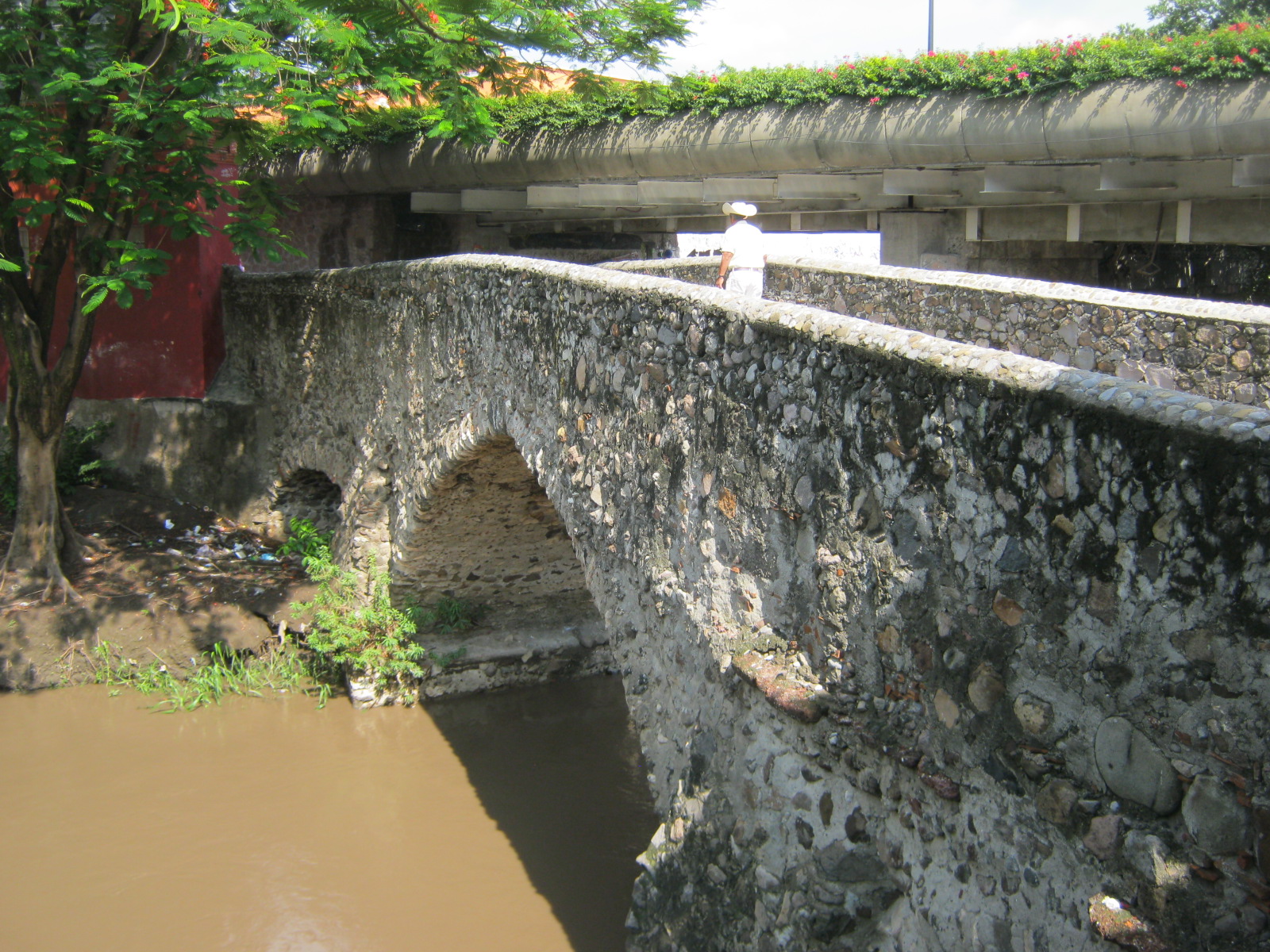
With a railing-height stone-wall on each side, the old bridge is wide enough for a horse drawn carriage or a cart pulled by a team of oxen. As I walked across I imagined traversing the bridge 4 to 500 years ago as part of the Camino Real from Mexico City to Acapulco. It is certainly one of the very few places where the Camino survives in its original design. Even the roadway portion of the bridge is stone.
In addition to local traffic it is a bridge that was certainly crossed by viceroys on their way to Acapulco for the annual fair upon the arrival of the "Nao de China" -- the fleet from Manila. Alexander von Humbolt must have crossed it on his famous trip when he referred to that Royal Highway as the Road to Asia. He noted it was in Acapulco where one boarded a ship to the Philippines. During the viceroyalty period most everything that went back and forth between New Spain and the Philippines undoubtedly crossed this old stone bridge -- furniture, silk gowns, ivory, porcelain, silver coins minted in Mexico, cochineal dye, books, government documents. During the war for Independence the Insurgent army used it. Zapata headquartered his army in Puente de Ixtla for a portion of the Revolution. Before the automobile age, the Puente was crossed by those travelers who gathered for Mass at dawn in the Franciscan hermitage on the outskirts of Cuernavaca then set out as a group on their way to Acapulco. The bridge at Ixtla was certainly a landmark for them; one by which to gauge how far they had traveled, how far they had yet to go.
The new concrete bridge is barely wide enough for two lanes of vehicular traffic with no space for a sidewalk. Pedestrians are directed to the old bridge, now in its fifth century of constant use!
Though only half an hour south of Cuernavaca, Puente de Ixtla has a rural feel to it. Turn off the highway at the first exit to Puente de Ixtla and you're in a bustling town rarely visited by tourists. Many of the seemingly endless shops are selling agricultural products. The older part of town is close to the river; you'll know you're there when the street angles down. Turn left at the church and that street will take you right into the market. As you poke along, live chickens will be for sale within arm's reach of your car window. Two right turns get you back to the main street within sight of the bridges -- old and new. Puente de Ixtla's charm is not its architecture; it is its ancient bridge, its history which hopefully you will imagine as you block out the contemporary.
Parking is available across the street from the storefront office labeled SRE (Secretariat of Foreign Relations). Yes, Mexican passports can be requested in Puente de Ixtla! It is a federally sanctioned municipal passport office and one of only three in Morelos. In Puente de Ixtla, unlike the busy passport office in Cuernavaca, for only a hundred-peso surcharge, Mexicans file the paperwork for passport without an appointment, it's ready four days later. A photo studio, copy shop, and bank where necessary fees can be paid are all within two blocks of the SRE office. At the SRE office you are only two doors uphill from the bridge.
The second half of the town's name refers to obsidian. Obsidian is volcanic lava cooled so quickly it bypassed crystallization and became glass instead of rock. It was the source of ancient Mesoamerica's sharpest tools.
Teotihuacan, in the Valley of Mexico, was Mesoamerica's premier producer of obsidian tools. In fact, its financial success was based on it. Because of its abundance of obsidian Puente de Ixtla very likely fell under Teotihuacan's control during the time that Teotihuacan was central Mexico's religious, political, and financial powerhouse. When other cities or towns competed in the obsidian trade Teotihuacan's income was affected; it would send its warriors out to conquer the offending place and demand all obsidian production flow through Teotihuacan. Teotihuacan fit the classic definition of an empire, controlling distant colonies without an interest in controlling the territory between the metropolis and its colonies. What it was interested in was trade and its most important product was obsidian.
It was a wonderful day exploring a seemingly isolated yet unexpectedly busy town. I highly recommend a detour when you next visit Taxco.
Tuesday, June 5, 2012
Rice shapes and is shaped by history
Look in a grocery store and you will see that the most expensive rice is most likely labeled "Morelos". Deservedly so. Earlier this year Morelos rice was awarded a certificate of controlled designation of origin by Economy Secretary Bruno Ferrari. Just as tequila must be from Jalisco and Ataulco mangos from Chiapas, so Arroz Morelos must be from the state of Morelos.
A new rice harvest is in the works. The anxiously awaited rainy season is quickly approaching. Days will soon be cool, skies clear, vegetation greener. Driving south on the Cuernavaca-Acapulco road we'll be treated to scenes seemingly right out of Asia. Campesinos up to their knees in mud will be shaping terraces in which they'll plant individual rice sprouts in flooded fields.
In other parts of Mexico farmers scatter rice seeds in their flooded fields. From the top of the five-storied Mayan building at the Edzná archeological site in Campeche, I've watched light planes swoop down to land on the highway where burlap bags full of rice are poured into their hoppers. The planes take off again to drop rice in huge flooded fields in that very flat state. This would seem a more efficient and effective way to plant. Nevertheless the care and extra effort Morelos' rice farmers take in planting is recognized and rewarded.
Rice and sugar cane go hand-in-hand. They have been principal crops in Morelos for generations. Both were introduced by the Spanish conquerors who had acquired them from the Arabs. In fact both "arroz" and "azucar" derive from Arabic words. The Valley of Cuernavaca was ideal for the cultivation of cane and Hernan Cortez himself established its first sugar haciendas. An easy, almost care-free plant to grow, cane processing requires a large investment and workforce as well as an enormous supply of water.
Rice, the grain that produces the most calories per hectar, kept the workers going on the sugar haciendas. Large scale rice farming in Morelos began in Jojutla in the 1840s.
The rice mills also generated additional income for plantation owners. They even had a captive clientele in their own workforce who bought from them at the "tienda de raya" (company store).
The southern front of the Mexican Revolution was the direct response to the increasing land, water and labor hunger of the sugarcane haciendas. Emiliano Zapata headquartered his troops in a rice mill in Tlaltizapán while fighting for land reform.
Sugarcane continues to be grown in the Valley of Cuernavaca, now mostly on ejido and campesino-owned fields. It is milled in the government built, co-operatively run Ingenio Emiliano Zapata.
An unfortunate chapter in U.S. and Mexican history led coincidentally to rice farming improving dramatically in Morelos in the 1940's. U.S. President Roosevelt asked Mexican President Avila Camacho to send prominent Mexican citizens of Japanese descent to U.S. internment camps during World War II. Mexico’s president refused but under intense pressure ultimately compromised and agreed to relocate citizens of Japanese descent far from the U.S. border and the coasts.
Those relocated did not necessarily lose their property as befell most U.S. citizens of Japanese descent. Instead the decree required Japanese-Mexicans to relocate to either Guadalajara or the Federal District. For those already living in those cities it caused little disruption in their lives. For those living elsewhere it meant moving to Guadalajara or Mexico City, one week's notice. Many families were split, with a "Mexican-looking" spouse remaining where the family home was located and the "Japanese-looking" members of the family being uprooted.
In Mexico City the existing Japanese colony helped refugees find places to live. Sanshiro Matsumoto housed almost a thousand on his hacienda in San Jeronimo in the southern part of the Federal District. Matsumoto and Shunji Yoshida also gained permission to stretch the boundary of the Federal District in order to lease the Temixco hacienda just south of Cuernavaca. There they housed 660 other Mexicans of Japanese ancestry. These "residents" were allowed to farm in order to cover living expenses.
Recalling stories told by their grandparents they began farming rice in the Asian style--planting sprouts in the flooded fields instead of scattering the seeds. Morelos' farmers watched and learned. These temporary “residents” also started flower farms. Today roses are an important crop in the valley south of Cuernavaca.
"No hay rosas sin espinas" (there are no roses without thorns) is a Spanish saying. Appropriate to think of as we drive through the Valley of Cuernavaca and admire the lasting legacy of Mexico's citizens of Japanese ancestry who left such beauty, enduring quality, and sources of employment in spite of the tragedy that brought them there.
On another note: Starting today, the pharaonic Tecnologico de Monterrey campus in Xochitepec, overlooking rice, rose, and sugarcane fields, will be hosting the exhibit from Ellen Macdonald's collection of Mary Davis' photographs restored by Tec de Monterrey students. The inauguration is by invitation. The exhibit will open to the public tomorrow, weekdays 9 am-7 pm, through the month of June. A description of the exhibit and its origin is available at <http://charliesdigs.blogspot.mx/2012/05/old-photos-rediscovered.html>.
Tuesday, May 15, 2012
Jigsaw Puzzle at Xochicalco
For 37 years I have led study groups to Xochicalco in Morelos, one of my favorite archeological sites. The stellar Temple of the Plumed Serpent (Quetzalcóatl) is a masterpiece with its carved relief depicting what many scholars believe records a meeting of Mesoamerican astronomers, hosted by Mayas in a city far from their homeland.
Overlooked by many is a collection of large carved stones near the temple – most likely stones that fit into blank spaces on the temple face. Each time I lead a group I pose the challenge that someone in that group might figure out where these stones fit, as if they were pieces in a jigsaw puzzle. Albeit a heavy jigsaw puzzle. I even suggest it might be a worthy Ph.D. project. So far no one has taken the bait.
In 1910 archeologist Leopoldo Batres first worked on that colossal jigsaw puzzle located on an unusually high hilltop surrounded by flatlands in central Morelos. When Batres looked down into the valley he could see sugar haciendas in every direction. I doubt Batres, or even the hacendados themselves, were aware that the festering social unrest among workers on those plantations was about to erupt into the southern front of the Mexican Revolution. A year later Emiliano Zapata was a household name and the nation would plunge into a decade-long war that decimated the population of Mexico. A century later Emiliano Zapata remains a symbol of demands for social justice throughout the world.
Batres remained focused on the hilltop and the huge project he had started – putting Xochicalco’s Quetzalcóatl Temple back together stone by stone.
President Porfirio Díaz had appointed Batres, his personal friend, curator of archeology for the republic. Despite Díaz’ patronage and friendship Batres voiced a common complaint among archeologists – not enough funding. In order to make good use of the funding he did receive Batres demanded a full day’s work of his crew and awakened them before dawn with a cannon blast. He was reportedly quite a sight. Photos of the time show him sitting in a prominent place where he would shout out orders while dressed in a three-piece suit, monocle, and top hat.
Batres also worked at other important archeological sites, including Mitla, Teotihuacan, and the Templo Mayor. He is often criticized for his heavy-handed excavation and restoration techniques. At Teotihuacan he was under tremendous time pressure to restore the Pyramid of the Sun in time for the hundredth anniversary of Mexico’s independence from Spain on September 16, 1910. To hasten the project he used Alfred Nobel’s recent invention – dynamite. Batres claimed he only used small charges of dynamite to remove accumulated soil and vegetation. However, it was one of his “scientific explosions” that blew the temple off the top of the Pyramid of the Sun.
Batres’ restoration at Xochicalco was much more precise since there is only one place where each sculptured stone can fit. This jigsaw-puzzle nature of the restoration project guided Batres in restoring the slope and panel design of the temple – a trademark of Teotihuacan’s architecture and evidence that during most of its history Xochicalco functioned under the tutelage of much larger Teotihuacan.
After Teotihuacan’s collapse around 750 A.D., Xochicalco continued using Teotihuacan’s style of architecture, embellishing it with a cornice along the top of the horizontal panel. As Batres discovered, there was no other place for those triangular carved stones.
For most of the year the sun beats down on the south side of Quetzalcóatl’s Temple, causing it to expand and contract much more than the north side. Only from mid May – starting this week – through July is there direct sunlight on the north side of the temple. Consequently, it has fewer missing puzzle pieces and the carving is in much better condition.
I have always wondered how the deteriorated south side fits in with the rest. What more would we learn about the meeting of astronomers if the south side were properly restored?
The pyramid has what seems to be repetitive carvings of astronomer-priests sitting cross-legged among the undulations of the feathered serpent. Closer observation shows they are actually individualized portraits. Older participants have wrinkled and sunken cheeks, younger ones more youthful faces. Some keep their lips tightly clenched, and others’ more relaxed faces show their teeth. Fingers and toes are carefully carved; jewelry and feathered headdresses accurately portrayed. Deformed foreheads give away Maya ethnicity. Other astronomer priests are from various ethnic groups and each is accompanied by an emblem glyph of his city.
With today’s technology it would be possible to complete Batres’ jigsaw puzzle in a virtual way. No heavy lifting. On a computer screen, photographs of the sculptured stones piled just south of the temple could be moved around over a photograph of the temple itself and repositioned in their proper places. Will a reader visit Xochicalco, take the photos, and achieve archeological fame? All I’ve ever asked is that “thanks to Charlie for the idea” be included in the introduction to the thesis.
Tuesday, November 15, 2011
Scenic drive offers look into the past
This is my favorite time to make the drive between Cuernavaca and Mexico City. I am always transported in both time and place to 16th century Flanders and Pieter Breugel's famous painting, The Harvesters.


At the top of the Chichinautzin ridge one forgets the tropics of the valleys on either side. With a cold climate and frequent rain, there are no lush swimming pools and no bougainvillea. Sheep outnumber people. Instead of shorts and t-shirts, residents are more frequently seen in warm jackets.
Though the entire area looks like one big farm it is cooperatively-cultivated ejido land and for the ejido farmer, the oats harvest is now in full swing. Just as the oats were planted and fertilized by hand they will be harvested by hand. Then the are left in the field to dry in conical stacks without separating the grain from the stalk. Though oats, not wheat, the golden stacks of the 21st century are no different from those of Bruegel’s 16th century landscape.
There are no fences between farms but each farmer knows exactly where the boundaries are and harvests only his or her crop. It is only during the harvest that one can see how many holdings there are. On some farms stalks are still standing, in others they are in the process of being cut. In still others, they are already stacked in conical piles. The only difference in the harvesting methods used in Bruegel’s time and that of modern farmers on this ridge is that in a few weeks stationary baling machines will be brought to the fields and bales will be hand-loaded onto trucks. Harvesting remains a very labor-intensive process.
The ejido farm is a uniquely Mexican type of land holding system. Although the government of Mexico parceled out fields to landless peasant farmers, giving them the right to use it is as their own, the nation retains the title. An ejidatario cannot use his land for any purpose other than farming, nor can it be rented or sold. If it isn't cultivated or farmed appropriately it reverts back to the community and is given to one who will. Lázaro Cardenas, perhaps Mexico’s most beloved president as well as a general in the Revolution, believed the tremendous number of landless peasants was the spark that led to the violent social upheaval. He embraced Zapata’s ideas for land reform and the ejido is a legal concept that was his answer to the question "How do we give land to landless peasants and make sure they don’t turn around, sell it, becoming landless peasants again?" Finding an answer to the question could provide insurance against a future revolution. The ejido, modeled on prehispanic land use, without ownership, seemed to be an answer.
This is a grand time of year to travel over the ridge. From either direction on a clear day, both on the ascent and descent of the highway, one can see snow-capped Popocatepetl and Iztaccihuatl. Though much of the ridge is part of the Federal District and well-protected, when one enters the Valley of Mexico, one of the most densely populated areas of the world, trees and forests give way to miles upon miles of human habitation.
Along this storied Cuernavaca-Mexico City route are also the paths of Zapata and the Revolutionary Army, dozens of inactive volcanoes, even burros walking along modern superhighways. For the acute observer, there is always that moment when the centuries blur. With a little imagination you can enter Bruegel’s 16th century European world. Or, even Jose Maria Velasco’s 19th century landscape portrayals of Mexico as an amalgam of modernity and tropical naturalism. Bruegel’s painting even depicts a large distant lake. If the lakes of the Valley of Mexico had not been filled in would The Harvesters even more closely resemble today’s Chichinautzin ridge?


Take your choice. At great expense and dislocation you can fly five hours to New York City and see the original Bruegel painting or you could drive to the Chichinautzin ridge and be in the painting itself. In the lower right of the painting are picnickers and nappers. I suggest you take a picnic and a blanket and share a torta.
Subscribe to:
Posts (Atom)